
Five-star dragons and the star chase
Use free eggs and free spins first, keep every duplicate for fusion, and never spend a coin bank on a chase with no published rate.
Five-star dragons are the long chase in Dragon Arena. The listing names them directly, describing five-star unique dragons as something to find, and the official screenshots show the star row above each dragon. What the game does not publish is a rate, a pool or a recipe, so this page deals in routes and costs rather than probabilities.
Star tiers
Stars run one to five and sit above a dragon in the art. They are a tier label, separate from level, and the top of the scale is the five-star result the listing mentions.
| Label on the card | What it tells you | What it does not |
|---|---|---|
| Stars | Rarity tier of the dragon | Its exact stats |
| Element | Which of four colours it carries | Matchup numbers |
| Level | How far it has been raised | Its ceiling |
| Unique tag | Whether the listing calls it a unique | Its drop rate |
Reading a card correctly saves coins. A five-star dragon with an element you already cover is a quality upgrade, not a coverage one, and the element page explains why that distinction matters early.
Four routes to a high tier
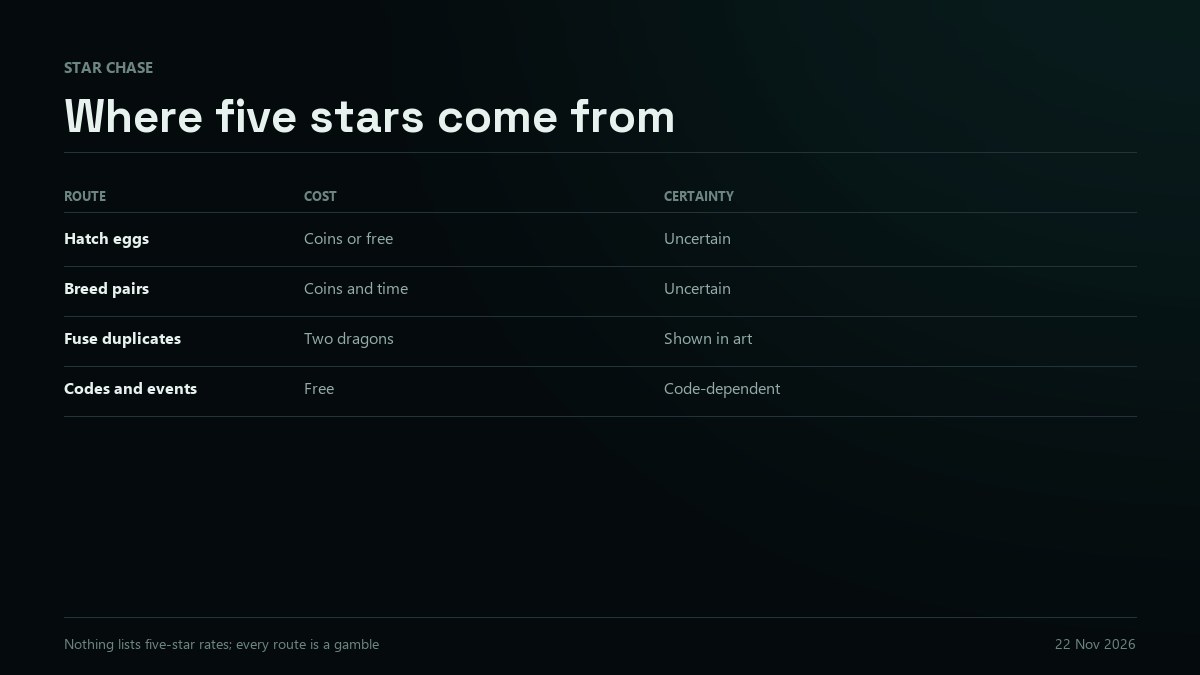
Every route below is named in the game or visible in its art. None of them has a published rate.
| Route | Cost | Certainty | Notes |
|---|---|---|---|
| Hatch eggs | Coins or free eggs | Unknown | The base source |
| Breed pairs | Coins and time | Unknown | Chosen combinations |
| Fuse duplicates | Two dragons | Unknown | Shown in listing art |
| Codes and events | Free | Depends on the code | One code confirmed |
The ordering in that table is also the ordering of effort. Free routes first, cheap routes second, fusion last, because fusion consumes dragons you might need.
The fusion picture, read carefully
One official image shows two dragons with star rows above them, a plus sign, and a larger dragon with five filled stars. That image is the only public hint that fusion exists.
What it shows: two dragons combine into one, and the result sits at the top of the star scale.
What it does not show: the cost, the rule for which pairs work, or whether the stars literally add. Treat the picture as a feature announcement rather than a formula, and test it with duplicates you can afford to lose.
Chasing without burning a bank
A five-star chase can consume everything you own if you let it. Three habits keep it sane.
- Spend free rolls first: the group egg, the code spin, then any event freebie.
- Keep every duplicate until you know what fusion wants.
- Set a stopping rule before you start, such as one plot tier's worth of coins.
| Habit | What it protects |
|---|---|
| Free rolls first | Your coin bank |
| Duplicates kept | Fusion options |
| A stopping rule | The session's income |
| A written log | Learning across sessions |
Why the chase is a late goal
A five-star dragon improves a team that already works. It does not unlock a plot feature, and it does not fix a coverage gap. Players who chase one before covering four elements usually end up with a strong dragon and a team that still loses a colour on the first bad wave.
The coins page puts the chase in the spending order for that reason: last.
Patience, by the numbers
The badge counts are a reminder of how long this game takes. Only 10,595 accounts have beaten the final boss, out of 1.77 million that hold the welcome badge. A five-star chase sits in the same long-horizon category, which is why it belongs after the systems are in place.
| Milestone | Accounts |
|---|---|
| Welcome badge | 1,773,504 |
| Beat the Ent | 757,957 |
| Beat the Magma Golem | 198,496 |
| Beat the Gargoyle | 10,595 |
Those numbers come from the badge funnel and move slowly. Use them for scale, not for planning a specific session.
Testing a fusion
When you are ready to test, do it with a controlled pair and write the result down.
- Pick two duplicates you can lose.
- Note each dragon's element and star tier.
- Fuse once, then read the result's element and stars.
- Repeat with one variable changed.
Two attempts tell you whether the stars add. Four attempts tell you whether elements matter. Neither is a rate, but both are yours.
Mistakes in the star chase
Rerolling a five-star result. The best outcome you can get is already in hand.
Fusing your only copy of an element. Coverage collapses and the wave punishes it.
Buying spins for a chase. Unknown odds against a known wall again.
Chasing before the plot is done. Features outrank rarity.
Verify in game
Open a dragon card and read the star row. Then open the fusion or breed screen, if the game exposes one, and see whether it previews a result. A preview is a fact; a blank screen means the outcome is unknown until you commit.
Common questions
Can a five-star dragon hatch from a normal egg?
No rate is published either way. Treat every egg as a possible source and none as a guaranteed one.
Are five-star dragons always unique?
The listing mentions five-star unique dragons as a category. It does not say every five-star is unique, so this site does not claim it.
What should I do with a duplicate five-star?
Keep it. A duplicate at the top tier is the most valuable fusion material you can own, and there is no published reason to discard it.